 Posted by
 I recently completed a tea room in King of Prussia PA for a tea practitioner. The process of designing and building this tea room presented some unique opportunities to expand my own capabilities as the project progressed.
This build happened over a fairly long time horizon so you’ll see an evolution to the workshop along the way.
During the project the client for this tea room returned from a trip to Japan with an enthusiasm to have her room feature many of the aspects that she had seen. One of the features that she wanted me to design into this room was a bamboo woven window which I agreed to knowing that with the bamboo window I would need to learn to plaster.
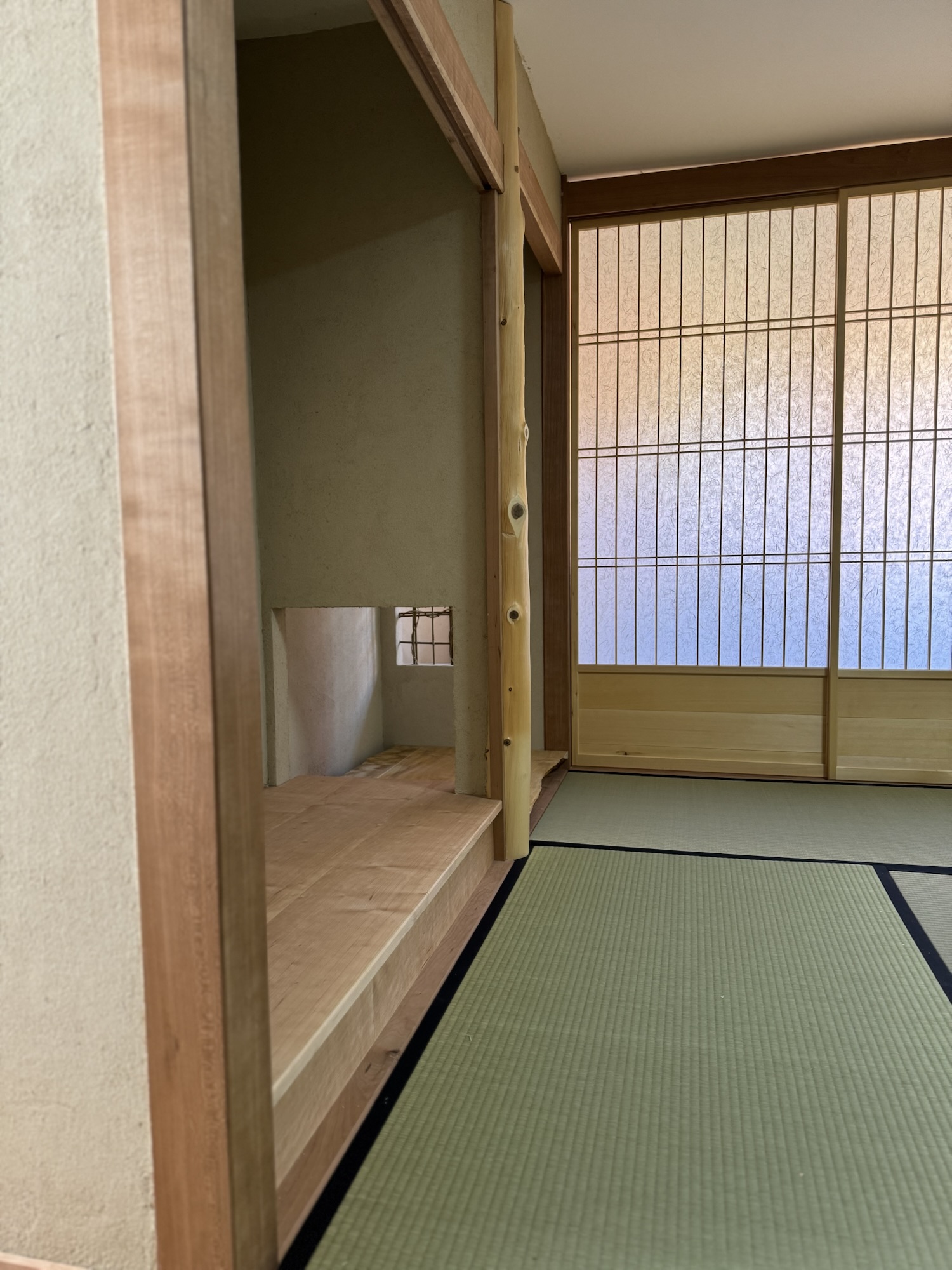
The room itself is a facade housed within an existing room, but I build it as if it were a structure. I find it to be a better approach than attempting to make faux, especially when including traditional items such as the tokonoma which typically features a peeled post known as the tokobashira. This post is typically joined into the structure of the home.

For indoor structures I create the posts and beams by laminating the desired wood species around poplar. Poplar is structurally sound and it is nice and stable. The final result is a very accurate part that will show quartersawn cherry. For tea room installations it’s often very impractical to source green timbers and utilize them. The laminated posts and beams stay extremely accurate.

The process of making the posts and beams is a multi-part laminating and milling process. I do this to ensure that they are flat, accurate and that the final veneer thickness (1/4”) is uniform.

Once complete I brought the parts to exact lengths. Doing this ensures that joinery cut at the ends and along the length will land where desired. I’ve found being more and more accurate in this regard has improved my work over time.

With the parts cut to length accurately I could begin cutting mortises.

I’m working on the square posts and the tokobashira. On the tokobashira I decided to house it in a plywood fixture to make it easier to land my joinery.

The tokobashira was also grooved for a door jamb which would eventually go unused but remain in place.
With the posts complete, I finished working the beams, some of which are up to 14’ long. The laminated beams feature cherry and poplar in an arrangement where the poplar will be hidden inside the grooves. These beams remain very accurately flat.

Once prepped these were grooved and tenoned.


Once the tenons were cut, I installed them into the tokobashira so that I could scribe and set them into the post.

Once these were done, I could test fit and prepare to install. My friend Sydney helped me assemble the frame at the site. It doesn’t look like much at this stage in-spite of the hard and extensive work required to get there.

With the basic frame parts now built and installed, it was time to make the tokonoma and build the shoji that would be installed on the main window wall.

I built the shoji along side a few others.
Next I began building the walls which would close in the tokonoma. The tokonoma in this build was intentionally planned to be small, at this stage it was intended as a multi-purpose room but that would change over the course of the project.
I prepared poplar for the walls, something I very strongly prefer over standard studs. 8/4 poplar kiln dried is a much better material to work with and it stays accurate. I created the bamboo window and tied it with grass string. I did this in a semi-traditional manner.

After the walls were built I covered them in drywall. The plaster used on this project can go over practically anything. It has no trouble sticking to paint or wood and it goes onto bare drywall very nicely. Not knowing any better I mudded in the joints but later learned that this was unnecessary with this plaster.

At this point the project waited a bit for another craftsman to install his aspect of the work. I designed and built my scope and he designed and built his scope. Once his work was in my friend Anton and I began plastering.

During the process of building the room the client asked me to change a few things to accommodate a more traditional use for the space, which I was happy to do.
We decided to extend the tokonoma by adding a tokowaki which would feature a round window backed by a shoji panel. The tokowaki would be illuminated from the back and from the tokonoma with a pass through in the wall.
I began building the tokowaki walls utilizing poplar studs and for the window a stacked lamination of plywood.


Once the Tokowaki was framed in, Anton and I sheet rocked the space and began plastering. Now with a bit of experience we went in a detailed areas around the posts.
We plastered in around the staggered shelving and mizuya in additional to my work.

Along the way I also built and installed a live edge maple tokonoma floor and a cherry floor for the tokowaki.

Now with the room nearly complete I built a shoji. This was a unique piece for me and first time utilizing bamboo kumiko, which I joined in utilizing half-laps.

The simple pattern aims to balance the variety of patterns in shoji around the space with the bamboo of the tokonoma.
Once installed I was able to wrap up a few other areas of the room along with installing the tatami mats and leveling them out with the help of Anton.

The final area of the room to complete was a spot next to the tokowaki which needed some cherry flooring.
We have a ceiling install planned for the summer, so the uneven reveal at the ceiling level will be resolved.


Hope that you enjoyed following along with this build.
Hi Brian,
So nice to see a new post on your Blog site, and this project is certainly worthy of it! Watching the process unfold through your photos gave me a lot of insight to the amount of work you did to get the final results. There are so many perfectly executed details to marvel at, and such fantastic workmanship on your part. Your client must be extremely happy with this beautiful space.
Thanks, Glenn! Greatly appreciated! She is very happy with it!
This is very nice, Brian. It looks just like what I’ve seen in movies and documentaries. My youngest daughter always says less is more, and I agree. The Japanese understand this too, with their uncluttered rooms and minimal furniture. I’m also surprised that there’s a demand for this type of work in the US. I have a feeling there could be a market for it in Australia as well. Great work as always, Brian.
Thank you! I do very much love the aesthetic!
Exceptional work Brian. Thank you for sharing the progress shots with details.
Thanks, Everett! Much appreciated!