 Posted by
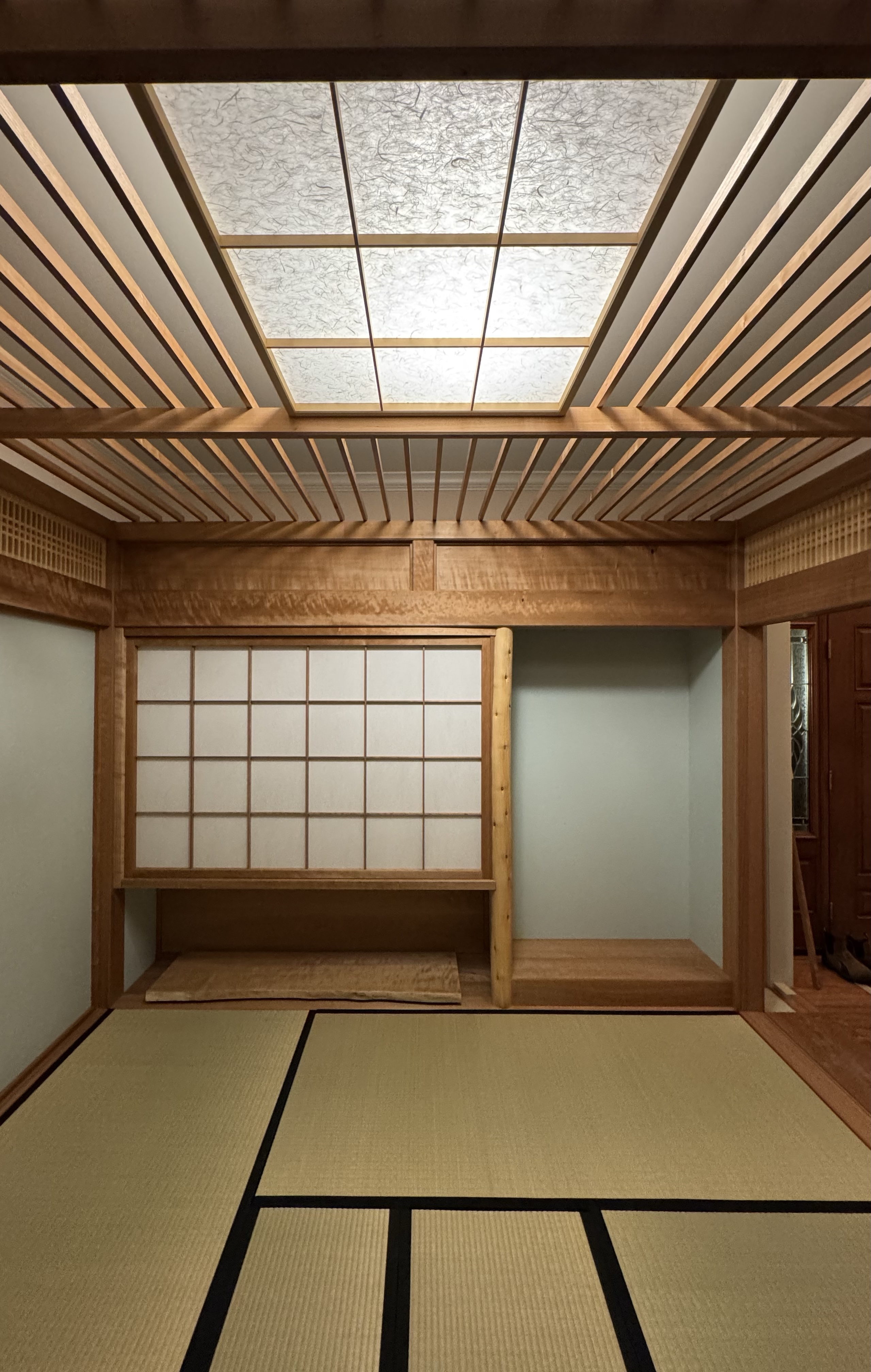
This post will detail a project I completed a few years back. This project is a freestanding tearoom for a tea practitioner.
This client reached out to me as her home was being built with the desire to have a freestanding tea room which she could use with the expectation that it could be broken down and moved in the future.
I designed this tea room around a 4.5 mat layout. My client desired her tea room to have multiple entrances which could be utilized to illuminate the space in addition to the standard host and guest entrances.

My scope of this project was to build the structure, along with the wooden panel doors, ceiling, shoji in the ceiling, the ranma panels above the solid doors and a wide slatted door which would be used to cover the mizuya.
Much of this project was built in my prior shop space so this post will feature both settings.
For this project my client requested a darker wood with good color and pattern. I recommended cherry which she enjoyed. For this structure I created fabricated posts and beams which would utilize draw-bored mortise and tenon joinery.
For these parts I utilize the method of stacking them as I laminate to ensure that they stay straight and accurate. The parts stayed accurate and remained that way even after recent disassembly of the structure to move it. This is a massive amount of work, prepping the material at each stage and very carefully making sequences matched veneers and ensuring they remain a uniform thickness.

One the laminations were complete, I was able to cut the mortises and tenons.


The tenons on this build were rather large so I cut them on the Martin T23 shaper with saw blades, then crosscut the shoulders on the then newly restored Graule.


With the mortises and tenons cut on the structure, I could then surface the parts on the Marunaka and prepare for assembly.

Doesn’t look like much, just yet but it will start to as parts populate the empty space.
Next up I created wooden panel doors which would serve as Fusuma doors. These panel doors are typically used on the exterior of a Japanese home but I’m using them in place of paper faced Fusuma.


Along with the wooden doors, I made panels for the areas above the shoji doors and tokonoma. These panels are solid cherry, quartersawn as is the other cherry utilized.

Along with the doors and panels I prepared and installed a simple slatted ceiling for the room that would house a shoji utilized to diffuse light from an overhead source.


Once I completed building and installing the slatted ceiling I started preparing a shoji panel for the center of the room.
After the shoji panel was complete I started building the ranma panels for above the wooden Fusuma doors. The ranma panels are slatted panels which allow airflow and create interesting shadows rather than diffusing light like a shoji panel would.


On the side of the structure which would feature shoji doors and on the opposite wall a tokonoma, I built solid cherry panels and housed them within the structure.

This completed my work on the tea room. After which I build a door to cover the wet bar which would be used in place of a fully traditional mizuya.


I hope that you have enjoyed following along with this project which I completed a few years back.


Beautiful work! I wouldn’t have thought of American Cherry. Turned out nice. Cheers, Stan
Thanks, Stan! Greatly appreciated! With a little age and without a film finish, quartered and rift Cherry fits right in with the softwoods.